
Room to Practice
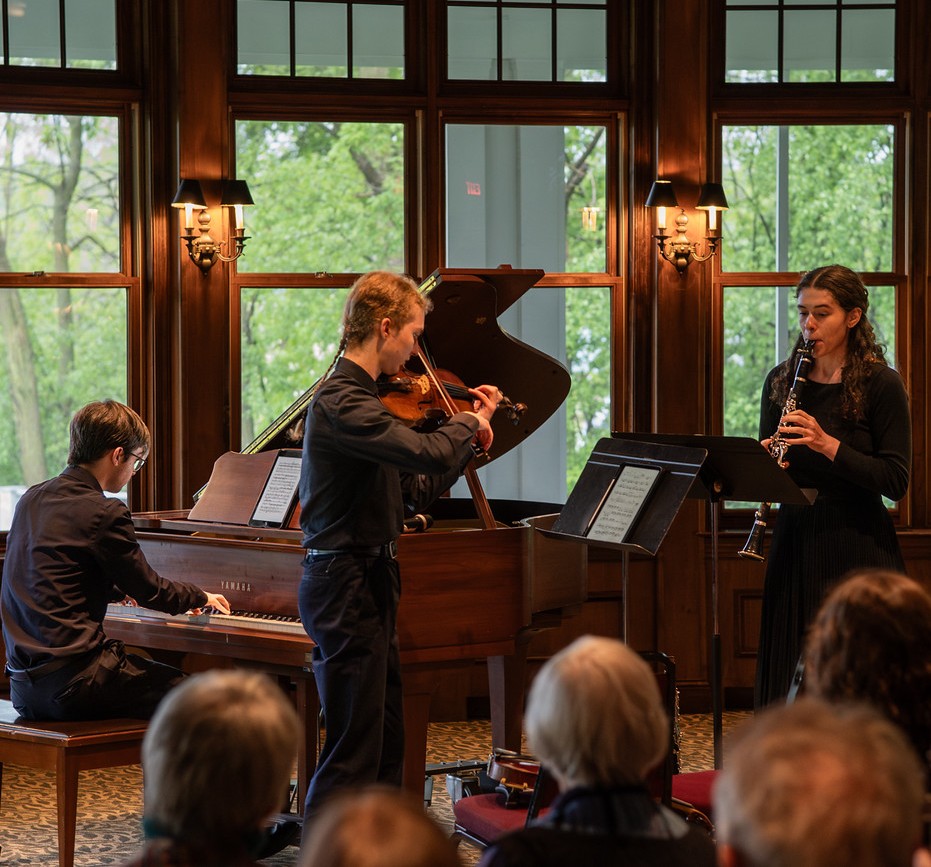
Isaac Epley ’27 took Lawrence’s inaugural How to Practice course as a first-year student in 2023. As he begins his senior year, he still draws on ideas he first encountered in that class.
A piano performance major with an emphasis in collaborative piano, Isaac spends much of his time making music with others. He accompanies singers, performs in operas and chamber ensembles, plays for recitals, and sings in the choir.
“Pianists tend to spend a lot of time in practice rooms alone,” Isaac says. “It’s very satisfying to put in that work and to get a lot of stuff done and then to get to meet with other people and put it together.”
The class gave Isaac a different way to think about that time alone.
How to Practice asks students to become more intentional about their practice. They try different approaches, reflect on what they learn, and figure out what works for them.
“I think about practicing as an opportunity to experiment,” Isaac says. “Rather than assuming that I already know how to practice or that I know what works for me or what doesn’t, it was a chance to try a bunch of different strategies out and then to hear what other people had to say.”
Faculty and staff from across Lawrence join the class, bringing perspectives from music, athletics, and other parts of campus.
Where the course came from
When Estelí Gomez and Catherine Walby ’97 developed How to Practice, they were responding to something they saw in their students: plenty of guidance during lessons and rehearsals. What happened the rest of the week was harder to see.
“There was a hidden curriculum, I think, and a background of what they are supposed to do all six days of the week other than that one day that I see them in a lesson,” says Gomez, a voice professor.
Walby, who teaches piano and keyboard skills, sees a similar gap in students’ preparation for independent practice.
“A lot of them haven’t had to practice a lot in high school,” she says.
There’s a practical side to the work, too. Students plan their weeks, think through how to use their time, and prepare for performances.
“There’s an acknowledgement that the administrative side of planning your practice is important, whether that’s strategizing what your week is going to look like, what your term is going to look like, or how you’re going to prepare for your recital,” Walby says.
Ruby Recht-Appel ’27, a vocal performance major, took the course as a sophomore after Gomez recommended it. At the time, she was trying to balance practice with classes, homework, sleep, and meals, and practice had become a source of guilt.
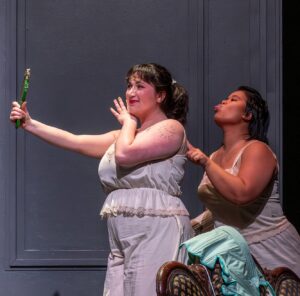
Ruby Recht-Appel ’27 (left) performs in Spring Opera Scenes, 2026.
“I thought of practice as the last thing I’d want to do,” Ruby says. “I was self-conscious because I felt like I didn’t know how to practice well or to use my time well.”
Now, she says, “I look forward to practicing because I know that I can get good work done.”
She also learned that practice doesn’t always require a practice room. A technique called silent practice, which she picked up from Opera Studies Professor Kristin Roach, lets her work through material when she can’t sing, whether she’s traveling, in public or doesn’t have room access.
Later, another technique stayed with her: chunking. She’ll focus on one task for 10 minutes, move to another and then circle back.
“It’s not just about pushing through everything,” Ruby says. “It can be about really focusing on this thing for a second and then moving on to this, and then coming back to that.”
What changes
Qiao Li ’25, a piano performance major, didn’t need to learn how to work hard. She already practiced constantly. What she hadn’t done was think much about how she used that time.
“I practice a lot,” she says. “I really didn’t think about the strategic way of practicing.”
One of the most useful ideas was simple: schedule practice rather than waiting for a three-hour block to appear in the day.
“Everyone is so busy,” she says. “There are days certainly I can’t just find a three-hour block that I can practice without any interruptions.”
She also began thinking differently about progress. During graduate school auditions, she sometimes compared herself with musicians who had started pursuing music much earlier.
“When I’m not motivated or think I am behind everyone because I didn’t decide to go into music until fairly late, I just think about that and I’m just like, I don’t really have to be like that person,” she says. “I’m just myself.”
For Isaac, one lasting lesson was learning to think of practice in terms of what works and what doesn’t, rather than simply labeling an approach good or bad. Instead of writing something off, he learned to ask what he liked about it, what he didn’t, and what might happen if he tried something else.
“It has turned my practice into a really active process,” he says, “something that I am really thinking about a lot, trying things, seeing what works and what doesn’t.”
Beyond the practice room
The class also draws perspectives from outside music. Eric Momberg, Lawrence’s fencing coach, was among them.
“From a mental perspective, high performance is high performance,” Momberg says. “It doesn’t matter if you’re a high-performance athlete, high-performance musician, high-performance chef. The mindset and the approach can be really, really similar.”
He also sees value in having students from different parts of the university hear from one another.
“We spend a lot of time in this day and age looking at how things are different, and I think a lot of ground can be made in looking at how things are similar,” he says.
Isaac remembers that mix from his first year: a lecture on mindful practice from religious studies and Momberg’s discussion of mindset and performance.
“It was really special to have the chance to hear from so many different departments,” he says.
Gomez has a former student in her studio who still talks about concepts from the course, including interleaving, or moving between different kinds of practice rather than working on one task in isolation.
“It’s not as though he was any less of an excellent musician,” Gomez says. “But he has more tools.”
Finding room to work
Learning how to practice is one thing. Finding a place to do it is another.
Ruby has felt the shortage directly.
“There are too many students for the amount of practice rooms,” she says. “There are times where it’s just like, oh, I can’t practice because there isn’t a room for me.”
She has sometimes practiced in Plantz residence hall, but the spaces aren’t soundproof. That can create problems when students are practicing near others who are studying or living nearby.
Faculty see the limitations, too. Gomez has given up office space so students can practice, and Walby notes that even the rooms that remain aren’t suited to every kind of work.
“You can fit in two, but when you’ve got a small chamber ensemble, I think that can be challenging to squeeze into some of those older practice rooms,” Walby says.
Isaac, by contrast, has generally been happy with the piano practice rooms available to him. He appreciates how well the instruments are maintained and can usually find a room when he needs one.
The space crunch extends beyond music. Fencing can require much of the Buchanan Kiewit Wellness Center’s indoor recreation space during practice, Momberg says, while track and field needs indoor space in the winter.
“We’re not adding more fields,” he says. “Every time that we add something, we are putting another ask on the spaces.”
A new kind of room
Level Up will create new places for that work.
The Hub, a new fitness, recreation and practice facility in downtown Appleton, will include a Conservatory practice suite with Wenger rehearsal modules, a recording studio, and a student lounge.
The Loop, an indoor training center adjacent to Alexander Gymnasium, will provide additional space for track and field and multiple sports. Moving specialized activities into dedicated spaces could also free up existing campus facilities for other students.
“As more space opens up, more opportunity opens up,” Momberg says.
For Isaac, the practice suite could offer a way to prepare for something that happens outside the practice room: performing in different spaces.
“When I perform in the Chapel or at Harper, even though Harper is a very different sound, it’s kind of really easy to be thrown off by the way that sound gets carried,” he says.
The Wenger modules would let students experiment with those differences before they encounter them on stage.
What the space can’t do
“The facilities by themselves are not practice,” Momberg says. “They can be a wonderful tool to make our practice more effective and more efficient.”
The right space can make that work easier. But the work is still theirs.
Posted September 17, 2026 in Donor Profile.